
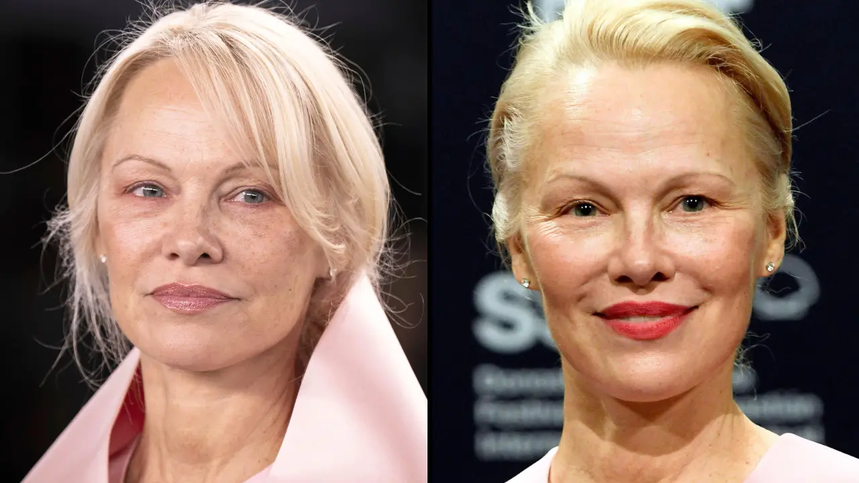

Pamela Anderson has revealed a ‘death sentence’ diagnosis that has left fans heartbroken.
Anderson has spent much of the past two years in the midst of one of the most remarkable career resurgences in Hollywood history.
Her critically acclaimed performance in The Last Showgirl, her return to comedy in The Naked Gun, and her decision to step onto red carpets without makeup have all contributed to a reappraisal of a woman the industry spent decades underestimating.
Now, honoured at one of the world‘s most prestigious charity galas, she has spoken about the hidden battle that shaped everything, a diagnosis she received that her doctor told her was a death sentence.
A night of recognition in Venice
The amfAR Gala in Venice is one of the most celebrated events in the international charity calendar a fundraiser for AIDS research held annually during the Venice Film Festival, attended by the global film and fashion elite.
This year, Anderson was honoured with amfAR’s Award of Courage, a recognition that acknowledged not just her decades of advocacy for HIV/AIDS awareness but the particular bravery it has taken to tell her own story honestly and publicly.
Speaking at the gala on September 6, 2026, the 59-year-old did not reach for the safe or the diplomatic.
She spoke, instead, with the directness and vulnerability that has defined her public persona in this new chapter of her life, addressing a secret she has carried for more than two decades and the way it shaped almost every decision she made.
The diagnosis that changed everything
Anderson first went public with her hepatitis C diagnosis in 2002, revealing that she had contracted the blood-borne viral infection by sharing tattoo needles with her then-husband Tommy Lee, with whom she shares sons Brandon, now 30, and Dylan, now 28.
At the time, the disclosure was met with significant public attention, though the full emotional and medical weight of the diagnosis was not something Anderson discussed in detail.
In Venice, she went much further.
“It was a death sentence,” she told the assembled guests, per Page Six. “That’s what my doctor told me, that I probably had around 10 years to live.”
She described the impact of those words on the years that followed.
“I’m sure that coloured and corrupted my decisions. It was not fear of death, but fear of what might happen to my young children. It turned my life inside out.”
For a woman who was at the height of her fame in the early 2000s, one of the most photographed and recognisable people on the planet, the knowledge that she was living under what she understood to be a terminal timeline was something she carried largely in private.
The diagnosis informed choices, she said, that she has only begun to fully process in retrospect.
Shame, guilt, and the weight of stigma
What made Anderson’s speech in Venice particularly powerful was her willingness to address not just the medical reality of her diagnosis but its emotional and psychological consequences, and, specifically, the stigma that attached itself to it.
“My experience of shame and guilt was also an unconscious journey,” she said.
“It stays with me; it haunts me. And just like the s**ual abuse that I endured as a child, it felt like it was carved into my forehead: damaged goods. And I presented myself as such.”
The parallel she drew between her hepatitis C diagnosis and the childhood s**ual abuse she has spoken about in other contexts is striking and deliberate.
Both, she suggested, became part of a self-image that she internalised without fully realising it — a sense of being fundamentally marked, compromised, less than. The way she moved through the world in the years that followed, she implied, was shaped by that feeling in ways she is still unpacking.
The stigma surrounding hepatitis C — a disease that carries associations with drug use and s**ual transmission, and that was in the 1990s and early 2000s frequently discussed in terms that placed moral weight on those who contracted it, per Mayo Clinic — was particularly acute for someone as visible as Anderson.
She was already one of the most scrutinised women in the world. The diagnosis added another layer to the judgment she was already navigating.
The road to recovery
The story, however, is not one of ongoing suffering. It is ultimately a story of survival, and of the extraordinary advance in medical science that made that survival possible.
In 2011, a cure for hepatitis C was developed, one of the genuine medical breakthroughs of the decade.
Anderson was able to access treatment, though she was candid in Venice about the financial cost of doing so.
“It took everything I had in my bank,” she said of paying for the treatment that ultimately cleared the virus from her system.
By 2015, she was confirmed hepatitis C free, a declaration she made public at the time in an interview with People, describing the experience of receiving a cure after more than a decade of living with what she had been told was a death sentence.
“Twenty years ago they told me I would die in 10 years,” she said in that 2015 interview.
“And 10 years into that, they told me I would be able to live with it and probably die of something else, but it all was very scary stuff.”
Of the cure, she added: “It’s exciting because now I get 20 years back on my life.”
Notably, Tommy Lee was also cured of the virus around the same period, having been cleared approximately a year before Anderson herself.
In Venice, she offered an update on where she is now, more than a decade after her cure. “I haven’t fully recovered,” she acknowledged. But she was also clear about the direction of travel.
What has allowed Anderson to process the experience, she said, is her work.
“My truth has come through my work, finding ways to express myself through the arts,” she said in Venice. “It gave me the ammunition I needed, a fertile life to use and play in.”
Her closing words at the gala were a direct and emphatic rejection of that narrative. “I’m not a victim, I’m a victor,” she said. “I am strong and capable, more now than I could ever dream of. I’m not the damsel in distress, no matter how easy that role is to play.”