
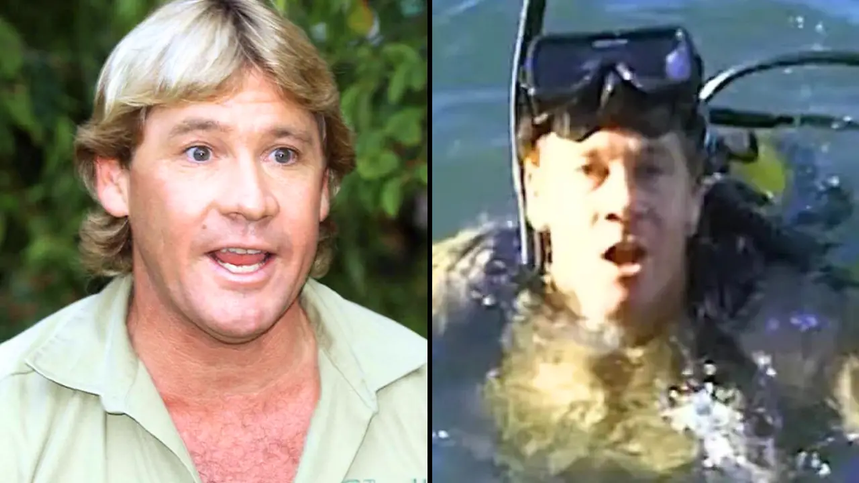

Twenty years after Steve Irwin’s tragic death, the final words of the beloved Crocodile Hunter continue to haunt those who were there, while the footage of his final moments remains hidden from the public.
It has been two decades since the world lost one of its most recognizable wildlife conservationists.
Steve Irwin died on September 4, 2006, at the age of just 44 after being fatally struck by a stingray while filming off the coast of Far North Queensland.
His children, Bindi and Robert Irwin, have both marked the anniversary by remembering their father and the impact he continues to have on their lives.
Bindi, who was just eight years old when Steve died, described her father as a ‘guardian angel’ and reflected on how his legacy of love has continued into another generation.
She revealed that her own five-year-old daughter watches Steve’s documentaries and feels a connection to the grandfather she never had the chance to meet.
“She feels utterly loved by the ‘grandpa crocodile’ without having met him,” Bindi said, per ABC.
Meanwhile, Robert, who was only two when his father died, also shared a tribute marking the extraordinary milestone.
Bindi and Robert remember their dad 20 years on
The 20th anniversary has brought another wave of emotional memories from those who knew Steve best.
Bindi reflected on the fact that she has spent the past two decades watching the world mourn her father alongside her family.
She said that while his conservation work is an important part of his legacy, she has come to understand that his greatest legacy was love.
Her tribute also highlighted the extraordinary way Steve’s memory has been passed down to his granddaughter.
Bindi said her five-year-old daughter watches his documentaries every morning and feels “utterly loved” by her “grandpa crocodile”, despite never having met him.
Robert has similarly continued his father’s work and has become a familiar face in wildlife television and photography.
At Australia Zoo, both siblings work alongside their mother to continue the conservation mission Steve dedicated his life to.
Their efforts mean that visitors today can still experience the environment that played such an important role in Steve’s life.
Australia Zoo’s current team includes Terri, Bindi, Robert and other conservationists working across wildlife protection and research.
Steve Irwin became a global wildlife icon
Steve was born in Melbourne, Australia, in 1962 and grew up surrounded by wildlife.
His parents, Bob and Lyn Irwin, moved the family to Queensland in 1970, where they established what was initially known as the Beerwah Reptile Park.
The wildlife park would eventually become Australia Zoo, which went on to form the heart of Steve’s conservation work.
From a young age, he developed an extraordinary passion for reptiles and wildlife, eventually becoming particularly well known for his fearless work with crocodiles.
His career changed dramatically when The Crocodile Hunter began reaching audiences around the world.
Alongside his wife Terri, Steve transformed wildlife television with his infectious enthusiasm, energetic presenting style and unmistakable Australian personality.
Millions of viewers watched as he came face-to-face with crocodiles, snakes, spiders, sharks and countless other animals.
But beneath the excitement was a serious conservation message.
Steve wanted people to understand wildlife rather than fear it, and his television work helped turn him into an international ambassador for conservation.
Australia Zoo says the family has continued that mission since his death, with the zoo now covering more than 700 acres and employing more than 500 people.
A last-minute change would lead to tragedy
Steve’s final day began with him working on a documentary called Ocean’s Deadliest.
He and his crew were filming around the Great Barrier Reef when poor weather affected their plans.
The crew eventually found themselves in calmer, shallower water, where Steve decided to film footage for another project.
What happened next would become one of the most shocking moments in wildlife television history.
Steve entered the water to film a stingray.
Stingrays are generally not aggressive toward humans, but the animal reacted when Steve moved above it.
The stingray suddenly lashed out with its barb, striking Steve in the chest.
The injury proved fatal.
Steve’s crew immediately attempted to save him and rushed him back toward the boat, desperately trying to keep him conscious.
But despite their efforts, there was nothing they could do.

Steve’s final words were caught on camera
Perhaps one of the most haunting details surrounding Steve’s death is that his final moments were captured by a camera crew.
Cameraman Justin Lyons, who was present during the incident, later described the frantic journey back to the boat.
As the crew tried to help Steve, they encouraged him to keep fighting.
Lyons recalled telling him to think about his children and to ‘hang on.’
According to Lyons, Steve then calmly looked up at him and said: “I’m dying.”
Those were reportedly the final words Steve spoke.
Lyons also recalled that Steve initially believed the stingray had punctured his lung, apparently unaware of the extent of the injury.
The stingray’s barb had caused catastrophic damage, with the injury ultimately proving fatal.
The circumstances were particularly devastating because Steve had spent his entire career getting remarkably close to some of the world’s most dangerous creatures.
Yet it was an encounter with an animal that is generally regarded as relatively peaceful that ended his life.
The footage has never been released
The existence of footage showing Steve’s final moments has fascinated and disturbed people for years.
However, the recording has never been made public.
John Stainton, Steve’s close friend and producer, was adamant that the footage should never be shown.
He had seen the recording himself but reportedly found it too distressing to consider releasing it.
Stainton previously made clear that the footage would not become part of a documentary or be broadcast to the public.
Steve’s family have also spoken about the decision not to release it.
Terri Irwin said she had never watched the footage herself and explained that she already knew how her husband died.
She also expressed relief that their children had not been present on the boat that day.
“Why would I? I know how my husband died, and I was relieved that the children weren’t on the boat as they usually would be; it would have been horrendous if they had witnessed it.”
Twenty years later, there has been no indication that the recording will ever be publicly released.
Instead, those closest to Steve have chosen to preserve his memory through his life and work rather than the final moments of his life.
Steve’s family continue his conservation mission
In the two decades since Steve’s death, his family have worked to ensure that his passion for wildlife did not die with him.
Terri continued their conservation mission, while Bindi and Robert eventually followed their father into television and wildlife work.
Australia Zoo remains at the centre of the family’s efforts, while conservation projects continue through the Wildlife Warriors organisation.
The zoo’s own history records that Steve’s family have worked to keep his mission alive and continue his philosophy of “Conservation Through Exciting Education.”
His influence has also stretched far beyond Australia.
Steve helped bring wildlife conservation into millions of homes and inspired generations of children to become interested in animals and the natural world.
Australian Geographic noted ahead of the 20th anniversary that his continuing influence can be seen through ongoing conservation work and field research, with his commitment to wildlife remaining a major part of his legacy.
Twenty years later, Steve Irwin is still remembered
On September 4, 2006, news of Steve’s death sent shockwaves around the world.
Two decades later, the sense of loss has not disappeared.
Instead, his family and the millions of people he inspired have turned their grief into a lasting conservation legacy.
Friends and colleagues have also been reflecting on the man behind the famous khaki shirt and trademark “Crikey!” — remembering someone whose enthusiasm for wildlife was genuine rather than simply a television persona.
Steve Irwin’s final words remain one of the most haunting details of his death.
But 20 years on, it is his life that his family wants people to remember.
The Crocodile Hunter may have died unexpectedly at just 44, but his message about protecting wildlife continues to reach new generations.
And through Terri, Bindi, Robert and the work carried out at Australia Zoo and beyond, Steve’s greatest passion remains very much alive.