
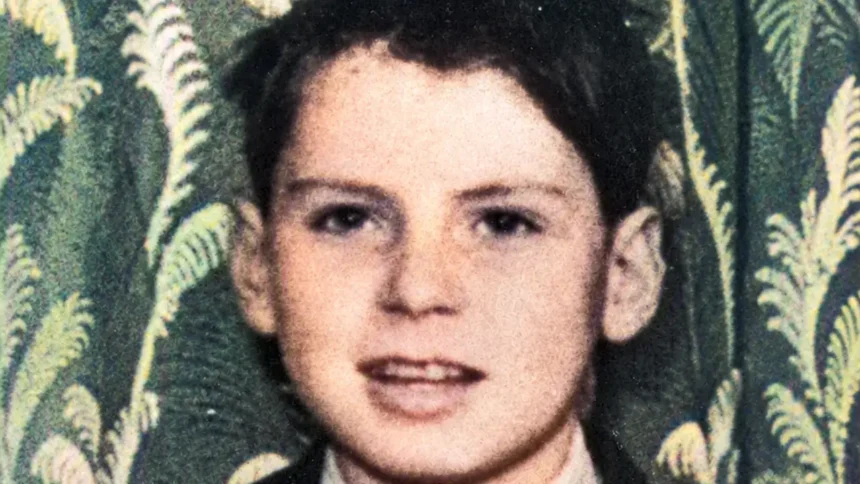

At first glance, there is little in the photograph to suggest that this little boy would become one of the world‘s most feared men.
He was born in Scotland in the aftermath of the Second World War and spent his earliest years in a small coastal community, surrounded by family and the familiar rhythms of countryside life.
As a young boy, he was described as quiet but adventurous. Some of his happiest memories centred around his maternal grandfather, a fisherman who would take him on long walks along the harbour, across the beach and towards the sand dunes.
For a time, his grandfather was the person he felt closest to.
He would later describe him as his ‘great hero and protector’ and recalled feeling that life was empty whenever the fisherman was away at sea.
But when the boy was just five years old, his childhood changed dramatically.
A devastating loss
On October 31, 1951, his grandfather died from a heart attack while fishing in the North Sea.
His body was brought back to the family home, where the little boy was taken to see him lying in an open coffin.
It became one of his most vivid childhood memories.
His mother told him that his grandfather was sleeping and had ‘gone to a better place.’
In the years that followed, the child became increasingly withdrawn.
He spent time alone around the harbour, watching fishing boats, and became less involved in family life. He also developed feelings of resentment towards relatives whom he believed gave more attention to his siblings.
There was another frightening moment during his childhood when he was nearly swept out to sea while playing alone on a beach.
As he struggled in the water, he later recalled believing that his grandfather was going to arrive and save him.
He survived after another boy pulled him from the water.
Soon afterwards, his mother remarried and the family moved away from his grandparents’ home.
The boy’s world was changing again.
Searching for a way out
As he grew older, he found life in the small Scottish community increasingly restrictive.
He was academically above average and had a particular interest in history and art, although he disliked sport. At 14, he joined the Army Cadet Force, seeing the military as a possible escape from his rural surroundings.
After leaving school in 1961, he briefly worked in a canning factory.
It did not last.
Instead, he decided to join the British Army and train as a chef.
The decision would take him far from the small Scottish town where he had grown up.
He excelled during his training at Aldershot and would later describe those years as some of the happiest of his life.
He travelled, gained new experiences and developed a career within the Army Catering Corps.
From the outside, he appeared to be building a perfectly ordinary life.
But privately, he was struggling with feelings and fantasies that he kept hidden from those around him.
A double life begins to emerge
During his military career, he became increasingly uncomfortable with his sexuality and concealed it from his colleagues.
He also began drinking heavily.
His postings took him to West Germany, Norway and Aden, where he worked as a military cook.
While serving overseas, his private fantasies became increasingly disturbing, eventually involving unconscious or dead bodies.
The young man who had once wandered along Scottish beaches with his grandfather was now carrying a secret inner world that was becoming increasingly detached from his everyday existence.
Yet there was still nothing about his outward life that would make those around him suspect what was to come.
After 11 years in the military, he left the Army in 1972.
He then moved into civilian life and eventually settled in London.
The quiet man in London
In London, he briefly joined the Metropolitan Police.
He completed his training and worked as a constable, but resigned towards the end of 1973.
He later found work as a civil servant.
Colleagues considered him quiet and conscientious. He was something of a loner and frequently worked overtime, but there was little to distinguish him from the thousands of other people living and working in London.
His private life, however, was becoming increasingly lonely.
He had several short-lived relationships, none of which developed into the permanent companionship he wanted.
By the late 1970s, he was living an increasingly solitary existence.
He drank heavily in the evenings, listened to music and became consumed by his private fantasies.
Then, in December 1978, everything changed.
The first murder
On December 30, 1978, he encountered a teenager in a pub in North London.
The teenager was 14-year-old Stephen Holmes.
The man invited him back to his flat, where they drank and listened to music.
The following morning, Holmes was dead.
He had become the first known victim in what would eventually become a five-year killing spree.
The killer concealed the crime and continued living apparently ordinary life.
He would later describe the murder as the beginning of what he called an “avenue of death”.
For years afterwards, more young men would cross his path.
Many were vulnerable, homeless or living unstable lives. Some were met in pubs, while others were encountered around London’s streets and public transport network.
The pattern was horrifyingly simple.
He would offer company, food, alcohol or somewhere to stay.
Then his victims would disappear.
The killings continued
Between 1978 and 1983, at least 12 men and boys were killed.
The true number has been debated, with investigators believing there may have been as many as 15 victims, although the precise figure remains uncertain.
The murders took place at two North London addresses.
At his first home in Cricklewood, he was able to conceal victims for considerable periods before attempting to dispose of their remains.
When he moved to a property in Muswell Hill, he no longer had access to a private garden in which he could burn evidence.
Instead, he began attempting to dispose of remains through the property’s plumbing.
That decision would eventually bring his secret life crashing down.
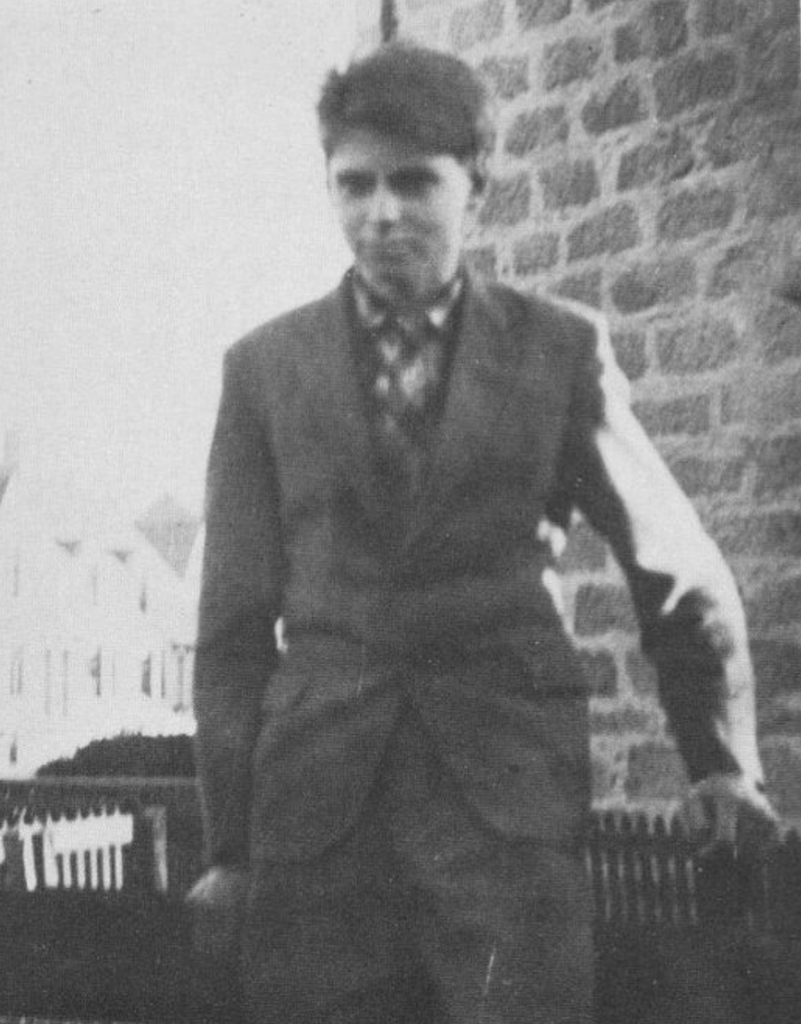
The mistake that exposed everything
By 1982, he had moved into an attic flat at Cranley Gardens.
There, he killed again.
One of the victims was 27-year-old Graham Allen.
After the murder, parts of Allen’s remains were disposed of through the toilet.
It was a catastrophic mistake.
The remains eventually caused problems with the drains.
In January 1983, a plumber investigating a blockage discovered material that appeared to be human tissue.
The police were called.
Investigators soon began examining the flat.
What they found was far worse than anyone had imagined.
The man who had spent years living quietly among his neighbours had been hiding evidence of multiple murders inside his home.
When police confronted him, he did not simply deny everything.
Instead, he began talking.
He eventually confessed to a series of killings and led investigators towards further evidence connected to his previous home in Cricklewood.
The scale of the case rapidly became apparent.
A shocking confession
The investigation uncovered evidence connected to numerous victims.
Police recovered human remains from the Cranley Gardens property and later searched the garden of his former home, where investigators found hundreds of fragments of bone.
The story quickly became national news.
The quiet civil servant had been exposed as a serial killer.
And the details of his confession were so disturbing that they would eventually become central to his trial.
He told investigators that he had struggled with loneliness, alcohol and an increasingly detached fantasy life.
When asked why he had killed, he famously told police:
“I’m hoping you will tell me that.”
Yet the prosecution would argue that he knew exactly what he was doing.
The trial
He went on trial at the Old Bailey in October 1983, facing six counts of murder and two of attempted murder.
The central argument was not whether he had killed the victims.
Instead, the court had to consider his state of mind.
The prosecution argued that he had been capable of controlling his actions and had acted deliberately.
The defence argued diminished responsibility.
Psychiatrists gave evidence about his personality and his apparent inability to form normal emotional relationships, while the prosecution presented evidence intended to demonstrate that he understood his actions.
The court also heard from men who had survived attacks.
Their testimony helped establish a picture of a man whose behaviour had become increasingly dangerous long before the full extent of his crimes was discovered.
After more than 12 hours of deliberation, the jury returned its verdict on November 4, 1983.
He was found guilty of six murders and two attempted murders.
He was sentenced to life imprisonment, with a recommendation that he serve at least 25 years.
The man behind the photograph
He would spend the rest of his life behind bars.
The minimum term was eventually replaced by a whole-life tariff in 1994, meaning he would never be released.
He was transferred between several prisons before eventually returning to Full Sutton, where he remained for the rest of his life.
Inside prison, he wrote extensively and produced a lengthy autobiography examining his childhood, his fantasies and his crimes.
He also maintained correspondence with people outside prison and spent time reading, writing, painting and working on music.
But none of it changed the enormity of what had happened.
At least 12 young men and boys had been murdered.
Some victims remained unidentified.
And decades later, questions continued over whether the true number was higher.
The man at the centre of the case died in hospital in May 2018, aged 72, after suffering complications following surgery.
So who was the little boy?
The photograph at the centre of this story shows a child who could never have known what his future held.
He had grown up in Fraserburgh, Scotland, had loved his grandfather, survived a near-drowning and eventually left his rural childhood behind for a life in the Army and then London.
For years, he managed to maintain the appearance of an ordinary existence.
He worked, made acquaintances, served in the military and even became a police officer before settling into a career as a civil servant.
Behind that outwardly unremarkable life, however, his fantasies and isolation were becoming increasingly disturbing.
And between 1978 and 1983, they culminated in a series of murders that shocked Britain.
The little boy in the photograph was Dennis Nilsen, the man who became known as the Muswell Hill Murderer, one of Britain’s most notorious serial killers.